The agentic workspace for GTM teams.
Agents research, prepare, keep the CRM current and follow up, so your time goes to the people you sell to.
Runs inside Claude, Codex and Kimi.
- Every fact cited to its source
- Works inside the AI tool you already use
- Nothing sent without you
Milan opens your day: who to call first, why today, what you owe and by when.
The moment you're missing.
A company starts moving toward a listing. New independent directors join the board. The auditor changes. It converts from a private company to a public one. By the time it is news, the deals around it are decided.
- 01A banker, before the founder starts planning
- 02A wealth manager, before the market
- 03Institutional sales, when the money lands
Seeing it
- 01Who fits?
- 02What has changed?
- 03Why does it matter now?
Acting on it
- 04Who can open the door?
- 05What makes the conversation relevant?
- 06What needs to happen next?
Celorus reads the signs early, and knows what each desk needs from them. The research, the records and the follow-ups are agents' work now. The judgement, the trust and the conversation stay yours.
The rest, done before you sit down.
Celorus makes Milan, the agentic workspace for GTM teams. Milan opens your day and keeps what you owe in front of you. Four agents do the rest. On Solo, this runs overnight. On the free workday, it runs when you ask.
More like your best clients
Finds more like the clients you already sell to, people or companies. A list, each name with the reason it is on it.
Word before the news
Tells you when a new name's moment arrives: a company going public, a fresh raise, a new director. An alert, with the source behind it.
When a client is ready for more
Tells you what changed in an account you already hold that opens the next sale. The change, with its source and the opening line.
Their coordinates, and the way in
Pinpoints who to reach, then finds the best way to them, starting with someone on your own desk. The path: who to ask, and what to say.
Nothing goes out without you. Agents prepare; you decide. See how the agents work together
From a change on the record to a meeting on the calendar.
These pages come from a sample desk: the firm, the company, the family and every name on them are made up.
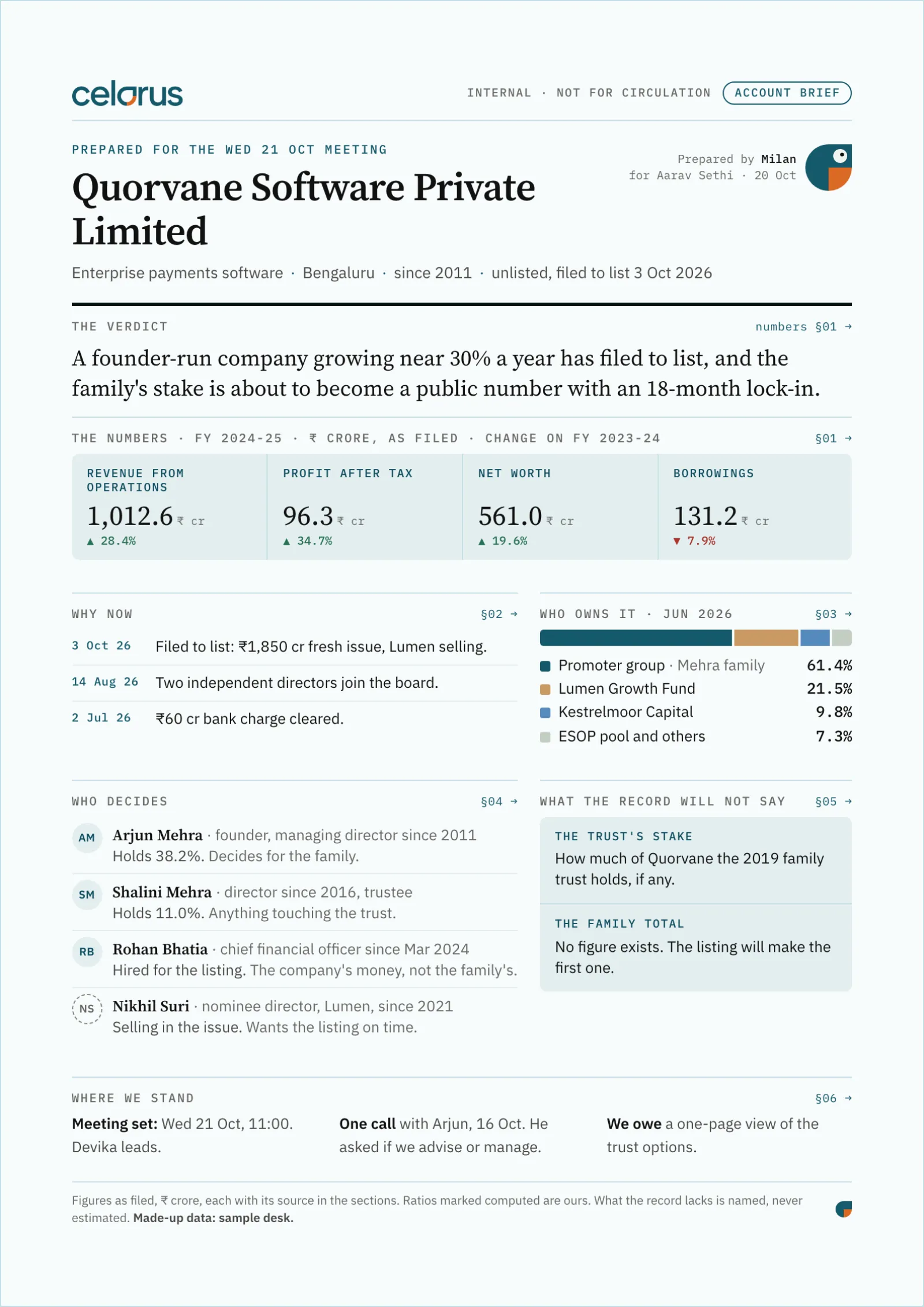
The change lands on your desk with its reason.
A company files to list, or new directors join its board. Milan puts it on your desk as an account brief: the verdict, the numbers as filed, and why now, each with its source.
- What changed, and when
- The numbers, as filed
- Who owns it, and who decides
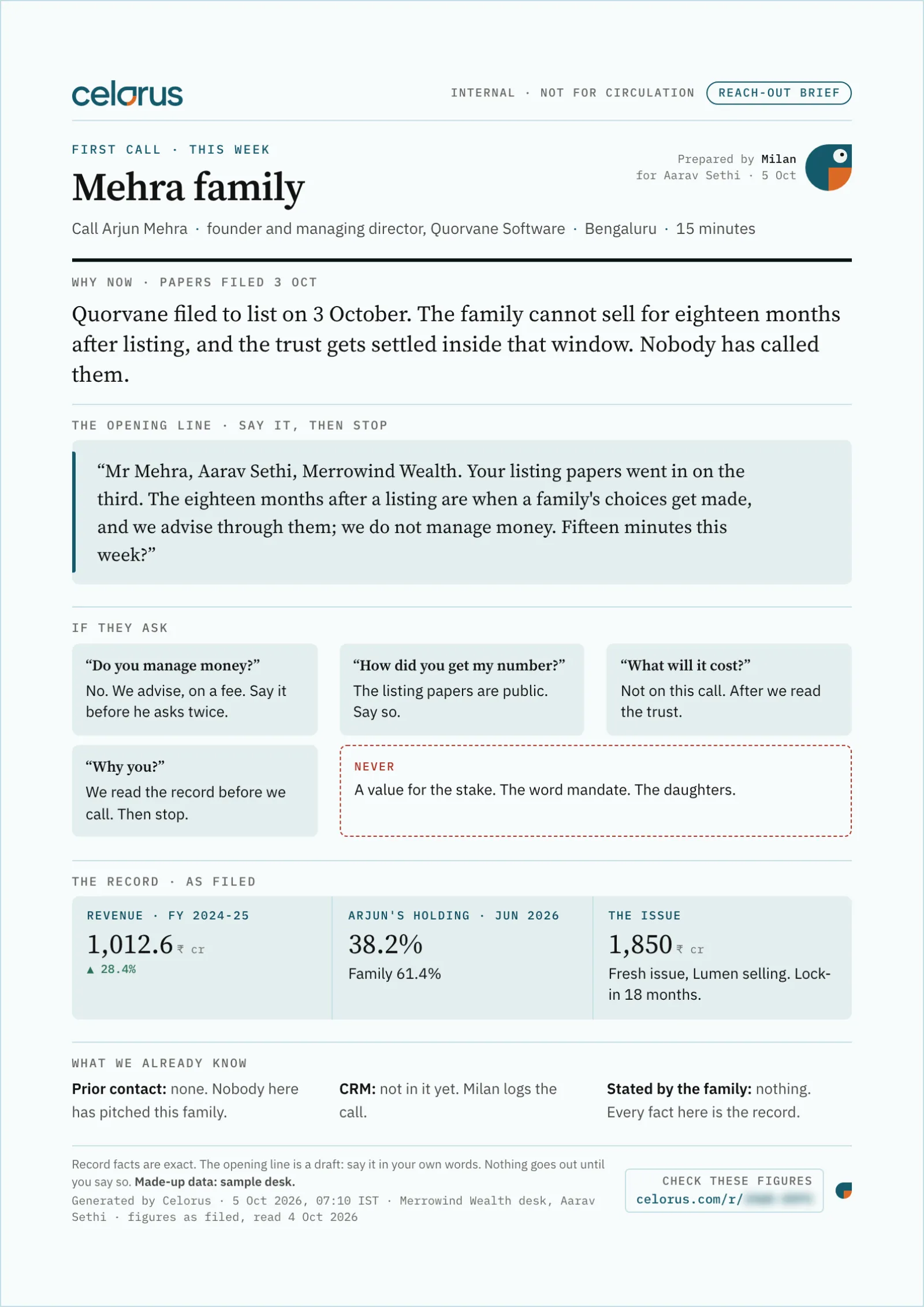
Know who to call, and what to say first.
The reach-out brief names the person to call and why now, then writes the opening line. It answers the questions they will ask, and lists what never to say.
- Who to call, and why now
- The opening line, and what they will ask
- What never to say
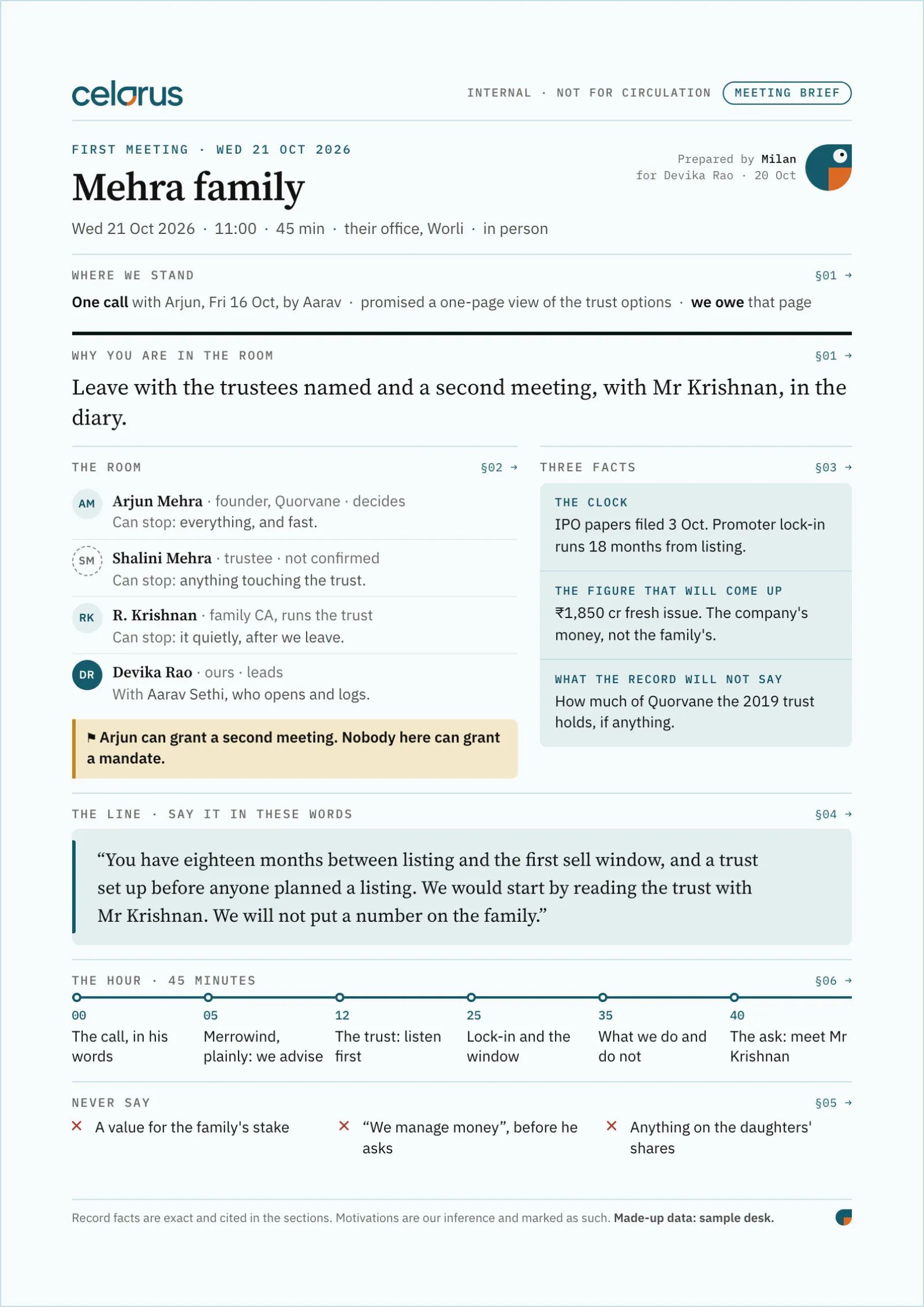
You know the room before you walk in.
The meeting brief gives you the room: where you stand, why you are there, who is in it and what each person can stop, and the facts that will come up.
- Who decides, and what each person can stop
- Why you are in the room
- Three facts, and what the record will not say
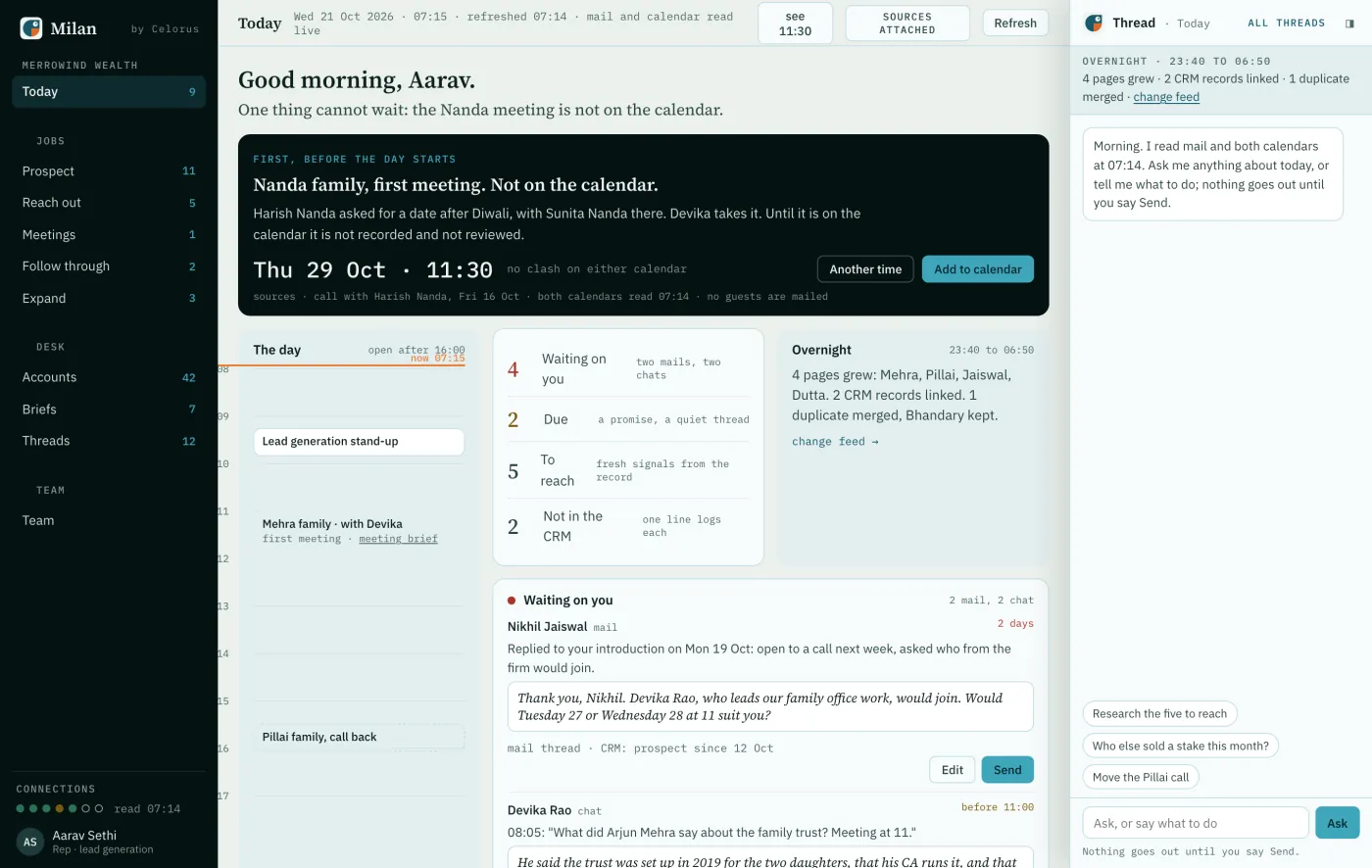
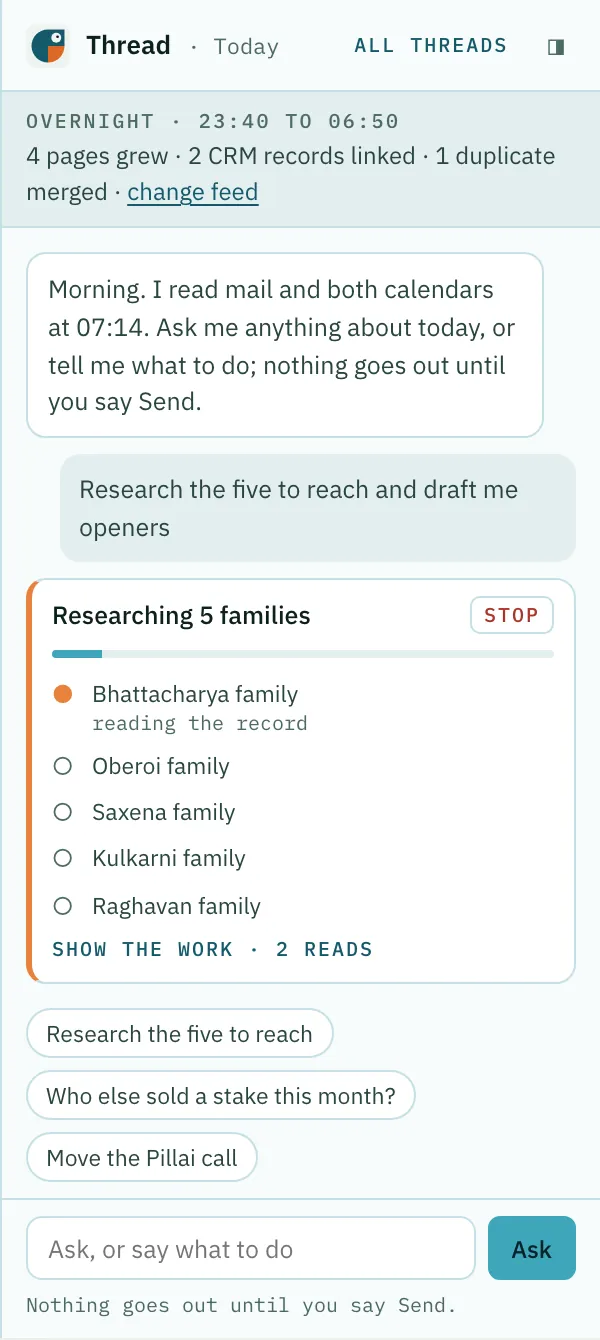
Each morning starts with what waits on you.
Milan opens the day with what moved overnight, then takes your word: research the five to reach, draft the openers, move a call.
- What moved overnight
- Ask, or say what to do
- Nothing goes out until you say Send
Built for your role.
Your list is ready before the day starts: who to reach, why today, and what to say.
You dial. The first line is on the card.
- More like your best clients, each name with its reason
- Milan's board: who first, and why today
- Drafted after: the note, the CRM entry, and the next step with its date
Walk into each meeting knowing who decides, why today, and who can introduce you.
You close. The meeting is yours, and so is your angle on why now.
- The brief: the company, the person who decides, what changed and when
- The way in: who on your desk already knows them
- Drafted after: the notes, the CRM record, the follow-up for you to send
Hear first when a client's world changes, with the opening line ready.
You grow the account, starting with the conversation the change opens.
- The alert on your clients and their companies, dated and cited
- The opening line for each
- Drafted after: the note, what you owe and by when, the CRM entry
See what each person is walking into, and where the team's attention should go.
You lead. Where attention goes this week stays your judgement. The team view comes with a team plan.
- The team view: each seat's day, the deals moving, the promises owed
- No asking for an update
- Drafted after: the hand-offs logged, the week's board for Monday
Nothing to replace. It works inside the AI tools the team already uses, and every fact carries its source.
You keep the system honest. The set-up is once: seats and an administrator.
- The CRM entries the agents drafted, each carrying its source
- Matched to a person or company only where the record settles it
- None is written until the seller says yes
Built for your industry. Every desk has its own clock.
| Industry | The clock | What happens | What you know first |
|---|---|---|---|
| Wealth management | Before the market knows. | When a family company heads for a listing, a stake sale or an acquisition, the family's money changes before the news does. | Who is about to come into money, so you call first |
| Institutional sales | When the money lands. | A raise, an asset sale or a loan paid off can leave a company holding cash it does not need yet. | Which companies hold spare cash, and why now |
| Investment banking | Before the founder starts planning. | That is when the banker is chosen, long before a banker is formally invited. | That the founder is about to start planning |
| Cloud service providers | When growth outruns the setup. | The company has raised, is growing fast, has opened a new subsidiary or region, or is heading for a listing. | The company, its growth and why now, before you pitch |
| GTM tech | When the GTM team is being built. | The company has just raised, entered a new market or put a new leader at the top, and is about to hire. | Which companies are about to build their GTM team |
Celorus sells to GTM teams and uses Celorus to do it.
Why not a general AI assistant?
Every claim carries its source
A general assistant answers from what today's web shows everyone, and guesses where the page is silent. Celorus knows who is who and reads a company's record back over years. Where the record is silent, it says "not available".
What's yours stays yours
Your book took years to build. Celorus works on your side: inside your assistant, and, on Solo, in your own Drive under a permission you can revoke in one click. Your desk is never pooled with another firm's. When the record can't answer a lookup, we use that to improve it, and what you looked up is never shown to another firm.
Infrastructure your own agents can use
The identity behind the people and companies on your list, and what your agents need to know about them, through one connector into any AI tool that speaks MCP. It is what our own agents run on, and yours can run on it too.
Six layers under every answer.
Your tools and our data, merged.
What your AI tool brings from your mail, calendar and CRM on one side. On the other, a deep data module per country: India today, with the UK, the US, Singapore and the UAE being added.
One record for each company, and for each person where the record settles it.
Every page is read by OCR and fixed rules. Celorus KF™ holds who is who and how they connect, and every agent works from it.
The moments that open a conversation.
Signal extraction reads every record for the moments that matter and files each one in the lead ontology.
Tuned to how your desk sells.
Wealth management, institutional sales, investment banking, cloud service providers and selling to sales teams, with more being added.
Your agents, inside the AI you already use.
Skill, model and tools, powered by Celorus KF™, running in Claude, Codex, Kimi or your own, through connectors, MCP and APIs.
Milan, your workspace.
Opens your day and keeps what you owe in front of you.
Three ways in. Start free.
- Free
Add it to your AI tool
The free plugin brings the workday into the AI tool you already use: open the day, research a lead, log the call. A free sign-in adds the record. Get the free plugin
- Solo
Let it run overnight
On Solo, the agents work before your day starts, and your desk lives in your own Drive. See Pricing
- Your team
Bring your team
One desk, three or more people, the clients you want more of, and, on Enterprise, a number we agree before day one and count on your desk. A working session is the first step.
We are new. Here is what you can check.
- The plugin is public on GitHub: read what it does before you add it.
- The price list is public, on one page.
- Every record figure on a sample brief says it is as filed, and when it was read.
- The founders' names and the company's registered details are on About.
- A person answers at tech@celorus.com.
For the people who were never called technical.
AI changed how engineers work. We're bringing that change to the people who were never called technical. About
What buyers ask us first.
Is it free?
Yes. Add the plugin to the AI tool you already use and your desk opens. A free sign-in adds the record.
Which tools?
Claude, Codex and Kimi, through the same connector.
Does anything go out without me?
No. Mail, messages and CRM entries wait for your word.
Where does my desk live?
In a folder on your side. On Solo, in your own Drive.
Can I use it with the AI tool we already have?
Yes, that is the point. See "Why not a general AI assistant?" above.
What does a plan add?
It is all on one page: Pricing.
Win the room. Agents do the rest.
No deck. An hour with the people who built it, on your own book.